As ongoing geopolitical tensions in the Middle East persist, energy market fluctuations continue to influence broader market volatility and long-term inflation trends. Recent naval operations and security measures near critical shipping corridors like the Strait of Hormuz led to disruptions in Gulf shipping throughout late July.
These supply constraints pushed oil prices noticeably higher. West Texas Intermediate (WTI) Crude surged 21% over the course of July, moving from roughly $70 per barrel to a peak near $93, before settling around $84 per barrel by July 27. Commercial crude inventories fell by 7.2 million barrels in late July to 404.5 million barrels (excluding the Strategic Petroleum Reserve), putting stockpiles roughly 7% below the five-year seasonal average.
At its July 29 meeting, the Federal Open Market Committee (FOMC) decided to hold the federal funds rate steady at 3.50% – 3.75%. However, bond markets reacted quickly: long-term Treasury yields rose as investors weighed the possibility of persistent inflation. The 10-year Treasury yield reached its highest point since January 2025, while the 30-year yield touched levels not seen since July 2007. Equity markets initially pulled back following the Fed’s announcement before recovering somewhat on strong corporate earnings reports, particularly within tech and artificial intelligence sectors.
Here is a closer look at the key economic indicators:
- Interest Rate Expectations: According to CME’s FedWatch tool as of August 3, futures markets indicated a 67.2% probability of a quarter-point rate increase at the upcoming September meeting.
- Consumer Sentiment: The University of Michigan’s Survey of Consumers showed one-year inflation expectations easing to 4.2% in July, down from 4.6% in June.
- Inflation Tracking: The Federal Reserve Bank of Cleveland’s Inflation Nowcasting tool projected annualized headline CPI to moderate slightly to 3.42% for July, down from 3.5% in June.
What Does the Data Add Up To?
The decision to hold rates steady highlighted investor concerns regarding prolonged inflation pressures, triggering a sell-off in Treasuries that drove yields upward. In its official statement, the Committee attributed ongoing price pressures primarily to energy sector supply shocks, while pointing to steady economic activity and low unemployment as signs of fundamental economic stability.
Notably, 3 of the 12 voting FOMC members dissented, favoring a rate increase to 3.75%–4.00%. This split suggests the Fed may consider a tighter monetary stance heading into autumn. While consumer and institutional forecasts project near-term cooling, overall inflation rates (4.2% and 3.42%, respectively) remain above the Fed’s baseline 2% target. Energy price spikes have visibly impacted public expectations, which have drifted upward from 3.4% earlier this year.
While the Fed reiterated its commitment to long-term price stability, officials refrained from offering explicit forward guidance. This is a sign that policymakers are likely waiting for complete inflation data before finalizing future policy adjustments.
Chart of the Month: Crude Oil Prices Remained Tumultuous in July
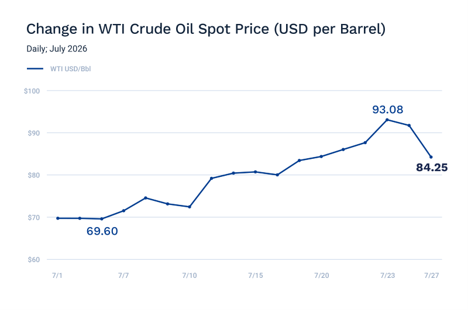
Source: Federal Reserve Bank of St. Louis via FRED (DCOILWTICO)
Although oil prices pulled back slightly during the final week of July as maritime traffic stabilized, geopolitical factors remain dynamic, leaving the precise timeline for energy price stabilization uncertain.
Equity Markets in July
- S&P 500: Gained 0.7% for the month, closing at 7,489.72.
- Nasdaq Composite: Declined 1.7% amid technology sector adjustments, ending at 25,373.85.
- Dow Jones Industrial Average: Rose 0.58% to close at 52,485.03.
Bond Markets in July
- 10-Year U.S. Treasury Yield: Closed at 4.75%, reaching its highest level since January 2025.
- 30-Year U.S. Treasury Yield: Ended the month at 5.28%, its highest level since July 2007.
- 2-Year U.S. Treasury Yield: Closed at 4.29%, reflecting broader yield adjustments across shorter maturities.
The Smart Investor
July’s market activity reflects the complex interplay between global events, central bank policy, and shifting economic data. For busy professionals balancing demanding careers and family priorities, short-term market fluctuations can feel distracting. However, successful long-term financial management isn’t about predicting every market shift—it’s about maintaining a resilient, well-structured financial plan designed to navigate changing environments.
A thoughtful, diversified approach helps keep your long-term wealth goals on track regardless of temporary noise. If you have questions about how current macroeconomic trends impact your personal retirement or investment strategy, our team is always here to help you review your plan.
August Market Commentary – Fed Holds, Investors Sell
August Market Commentary – Fed Holds, Investors Sell
As ongoing geopolitical tensions in the Middle East persist, energy market fluctuations continue to influence broader market volatility and long-term inflation trends. Recent naval operations and security measures near critical shipping corridors like the Strait of Hormuz led to disruptions in Gulf shipping throughout late July.
These supply constraints pushed oil prices noticeably higher. West Texas Intermediate (WTI) Crude surged 21% over the course of July, moving from roughly $70 per barrel to a peak near $93, before settling around $84 per barrel by July 27. Commercial crude inventories fell by 7.2 million barrels in late July to 404.5 million barrels (excluding the Strategic Petroleum Reserve), putting stockpiles roughly 7% below the five-year seasonal average.
At its July 29 meeting, the Federal Open Market Committee (FOMC) decided to hold the federal funds rate steady at 3.50% – 3.75%. However, bond markets reacted quickly: long-term Treasury yields rose as investors weighed the possibility of persistent inflation. The 10-year Treasury yield reached its highest point since January 2025, while the 30-year yield touched levels not seen since July 2007. Equity markets initially pulled back following the Fed’s announcement before recovering somewhat on strong corporate earnings reports, particularly within tech and artificial intelligence sectors.
Here is a closer look at the key economic indicators:
What Does the Data Add Up To?
The decision to hold rates steady highlighted investor concerns regarding prolonged inflation pressures, triggering a sell-off in Treasuries that drove yields upward. In its official statement, the Committee attributed ongoing price pressures primarily to energy sector supply shocks, while pointing to steady economic activity and low unemployment as signs of fundamental economic stability.
Notably, 3 of the 12 voting FOMC members dissented, favoring a rate increase to 3.75%–4.00%. This split suggests the Fed may consider a tighter monetary stance heading into autumn. While consumer and institutional forecasts project near-term cooling, overall inflation rates (4.2% and 3.42%, respectively) remain above the Fed’s baseline 2% target. Energy price spikes have visibly impacted public expectations, which have drifted upward from 3.4% earlier this year.
While the Fed reiterated its commitment to long-term price stability, officials refrained from offering explicit forward guidance. This is a sign that policymakers are likely waiting for complete inflation data before finalizing future policy adjustments.
Chart of the Month: Crude Oil Prices Remained Tumultuous in July
Source: Federal Reserve Bank of St. Louis via FRED (DCOILWTICO)
Although oil prices pulled back slightly during the final week of July as maritime traffic stabilized, geopolitical factors remain dynamic, leaving the precise timeline for energy price stabilization uncertain.
Equity Markets in July
Bond Markets in July
The Smart Investor
July’s market activity reflects the complex interplay between global events, central bank policy, and shifting economic data. For busy professionals balancing demanding careers and family priorities, short-term market fluctuations can feel distracting. However, successful long-term financial management isn’t about predicting every market shift—it’s about maintaining a resilient, well-structured financial plan designed to navigate changing environments.
A thoughtful, diversified approach helps keep your long-term wealth goals on track regardless of temporary noise. If you have questions about how current macroeconomic trends impact your personal retirement or investment strategy, our team is always here to help you review your plan.
RECENT ARTICLES
October Market Commentary – The Fed Hikes as Treasury Yields Rise
Medicare Open Enrollment Starts October 15: What You Can Change for 2027
September Market Commentary – Stocks Rebound, The Test Waits
Gift or Loan: Helping a Child With a Down Payment
The Diversification Rule That Resets With Every Vest