The U.S.-Iran ceasefire that briefly brought calm to the financial markets earlier this spring has proved fragile. Flare-ups in late June and July have reminded us that geopolitical friction remains a constant backdrop. While a return to open conflict has been avoided so far, this ongoing unpredictability continues to keep global markets on edge.
Despite these headlines, June’s economic numbers delivered a welcome, albeit nuanced, surprise: inflation cooled significantly. Consumer prices fell 0.4% month-over-month—marking the sharpest single-month drop in headline inflation since April 2020.
Meanwhile, Federal Reserve Chairman Kevin Warsh chaired his first FOMC meeting, holding interest rates steady in the 3.50%–3.75% range. June’s softer CPI reading, paired with modest employment numbers, takes some immediate pressure off the Fed to raise rates further. However, markets are still pricing in about a 50% chance of a rate hike at the September meeting. Adding to the intrigue, Chairman Warsh has indicated a preference for shorter, less explicit public statements compared to past leadership, keeping market watchers on their toes.
In the markets, the Dow Jones Industrial Average reached new record highs, even as elevated valuations in artificial intelligence and semiconductor stocks led to pullbacks in the S&P 500 and Nasdaq. Bond yields experienced moderate swings before finishing the month relatively flat.
Let’s Get Into the Data
- Employment Dynamics: Nonfarm payrolls grew by 57,000 jobs in June, coming in below the consensus expectation of 115,000. This reflects the slowest month of job growth in four months, especially after downward revisions of 74,000 combined jobs for April and May. While headline unemployment dropped slightly to 4.2%, this shift was largely driven by a 0.3% dip in overall labor force participation.
- Inflation Relief: Headline Consumer Price Index (CPI) decelerated to 3.5% year-over-year, down from 4.2% in May. A 5.7% drop in energy prices served as the primary driver for this pullback—the first drop in energy costs since January. Core CPI, which strips out volatile food and energy costs, remained flat for the month.
- Economic Pace: GDP estimates have moderated. Reflecting softer domestic investment, the Atlanta Fed’s GDPNow model revised its Q2 growth estimate down to 1.2% as of July 1, compared to expectations near 3.0% earlier in June.
What Does the Data Add Up To?
For busy professionals balancing demanding careers with family priorities—like planning for upcoming college expenses or managing household cash flow—it helps to look beyond the surface of these reports.
June’s inflation drop is certainly a relief, but it isn’t necessarily a final resolution. The decline was largely driven by a temporary pullback in energy prices. With energy markets prone to rapid shifts based on global events, oil prices have already shown signs of bouncing back.
That said, there is genuine encouragement in the underlying numbers. Core inflation—which excludes food and energy—was unchanged for the month and stood at 2.6% year-over-year. Services inflation also remained flat. Because core CPI highlights sectors less vulnerable to sudden geopolitical swings, it offers a clearer look at structural trends. This underlying cooling suggests that while energy prices remain volatile, broader price pressures may be easing.
On the labor front, weaker seasonal hiring—even with summer activities in full swing—alongside a lower labor participation rate, points to a moderating economic backdrop rather than an overheated one. For the Federal Reserve, this combination of cooling core inflation and steadying job growth reduces the immediate urge to push interest rates higher, offering a more stable landscape for long-term financial planning.
Chart of the Month: Oil Prices Came Down, But Volatility Persists
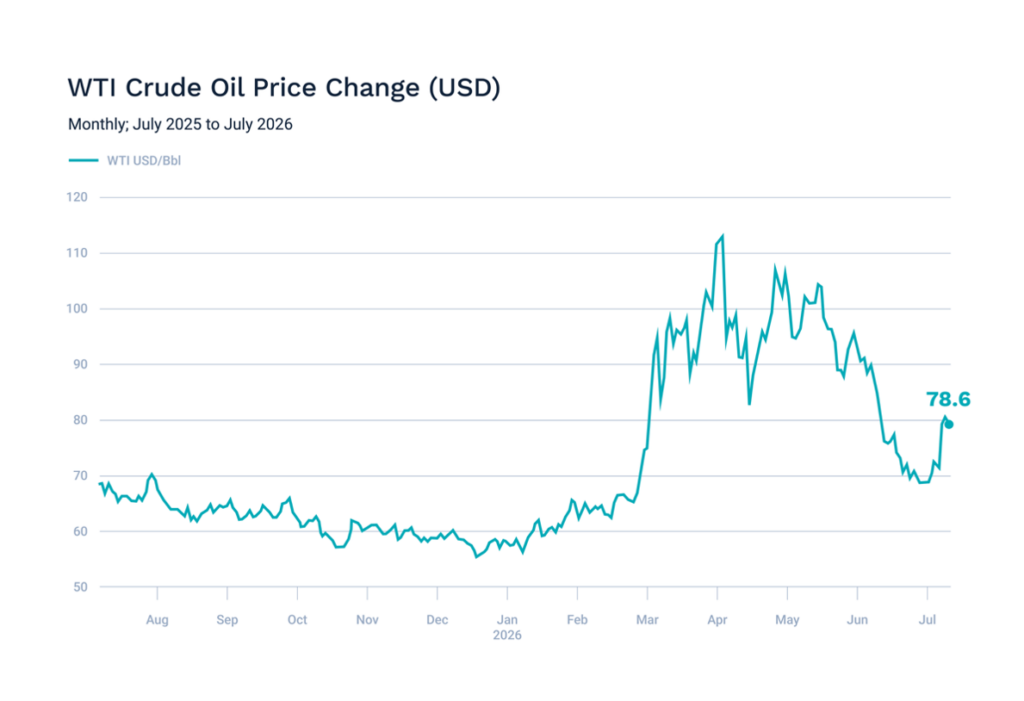
As demonstrated in the chart above, WTI Crude Oil prices experienced a noticeable drop in June following significant spring peaks, settling around $78.60 per barrel before ticking up again in July. This visual reinforces why energy fluctuations can briefly distort headline CPI data, and why focusing on core inflation gives us a clearer picture when managing long-term portfolio strategies.
Equity Markets in June
- S&P 500: Decreased 1.1% to close at 7,499.36, marking its first monthly dip since March.
- Nasdaq Composite: Eased 2.9% to 26,213.72 as high-flying tech and semiconductor valuations faced increased scrutiny.
- Dow Jones Industrial Average: Rose 2.5% to a record 52,319.20, supported by market rotation into value and broader economic sectors.
Bond Markets in June
- 10-Year U.S. Treasury: Yield ended at 4.42%, easing after reaching high points near 4.69% earlier in the quarter.
- 30-Year U.S. Treasury: Yield adjusted to 4.90%, down from 4.99% in May.
- Bloomberg U.S. Aggregate Bond Index: Generated a modest positive return of 0.31% for the month as fixed-income yields stabilized.
The Smart Investor
June’s data shows that while economic conditions are improving in key areas, uncertainty remains part of the equation. Inflation has eased, but energy prices stay dynamic. Hiring has slowed, but overall employment remains stable. Meanwhile, the Federal Reserve is entering a new chapter under Chairman Warsh, with less explicit guidance on future rate paths.
When balancing high-level professional responsibilities with long-term family goals—whether that involves funding education targets, reviewing estate plans, or managing strategic tax strategies—attempting to time market cycles or predict short-term swings is rarely necessary. Successful financial planning relies on building a well-structured, diversified strategy designed to navigate changing economic seasons comfortably.
If you would like to review how recent market trends align with your current wealth plan, or if you’d like to discuss strategies to optimize your cash flow and tax efficiency, please feel free to reach out to our team.
July Market Commentary – A Long-Awaited Inflation Cooldown
July Market Commentary – A Long-Awaited Inflation Cooldown
The U.S.-Iran ceasefire that briefly brought calm to the financial markets earlier this spring has proved fragile. Flare-ups in late June and July have reminded us that geopolitical friction remains a constant backdrop. While a return to open conflict has been avoided so far, this ongoing unpredictability continues to keep global markets on edge.
Despite these headlines, June’s economic numbers delivered a welcome, albeit nuanced, surprise: inflation cooled significantly. Consumer prices fell 0.4% month-over-month—marking the sharpest single-month drop in headline inflation since April 2020.
Meanwhile, Federal Reserve Chairman Kevin Warsh chaired his first FOMC meeting, holding interest rates steady in the 3.50%–3.75% range. June’s softer CPI reading, paired with modest employment numbers, takes some immediate pressure off the Fed to raise rates further. However, markets are still pricing in about a 50% chance of a rate hike at the September meeting. Adding to the intrigue, Chairman Warsh has indicated a preference for shorter, less explicit public statements compared to past leadership, keeping market watchers on their toes.
In the markets, the Dow Jones Industrial Average reached new record highs, even as elevated valuations in artificial intelligence and semiconductor stocks led to pullbacks in the S&P 500 and Nasdaq. Bond yields experienced moderate swings before finishing the month relatively flat.
Let’s Get Into the Data
What Does the Data Add Up To?
For busy professionals balancing demanding careers with family priorities—like planning for upcoming college expenses or managing household cash flow—it helps to look beyond the surface of these reports.
June’s inflation drop is certainly a relief, but it isn’t necessarily a final resolution. The decline was largely driven by a temporary pullback in energy prices. With energy markets prone to rapid shifts based on global events, oil prices have already shown signs of bouncing back.
That said, there is genuine encouragement in the underlying numbers. Core inflation—which excludes food and energy—was unchanged for the month and stood at 2.6% year-over-year. Services inflation also remained flat. Because core CPI highlights sectors less vulnerable to sudden geopolitical swings, it offers a clearer look at structural trends. This underlying cooling suggests that while energy prices remain volatile, broader price pressures may be easing.
On the labor front, weaker seasonal hiring—even with summer activities in full swing—alongside a lower labor participation rate, points to a moderating economic backdrop rather than an overheated one. For the Federal Reserve, this combination of cooling core inflation and steadying job growth reduces the immediate urge to push interest rates higher, offering a more stable landscape for long-term financial planning.
Chart of the Month: Oil Prices Came Down, But Volatility Persists
As demonstrated in the chart above, WTI Crude Oil prices experienced a noticeable drop in June following significant spring peaks, settling around $78.60 per barrel before ticking up again in July. This visual reinforces why energy fluctuations can briefly distort headline CPI data, and why focusing on core inflation gives us a clearer picture when managing long-term portfolio strategies.
Equity Markets in June
Bond Markets in June
The Smart Investor
June’s data shows that while economic conditions are improving in key areas, uncertainty remains part of the equation. Inflation has eased, but energy prices stay dynamic. Hiring has slowed, but overall employment remains stable. Meanwhile, the Federal Reserve is entering a new chapter under Chairman Warsh, with less explicit guidance on future rate paths.
When balancing high-level professional responsibilities with long-term family goals—whether that involves funding education targets, reviewing estate plans, or managing strategic tax strategies—attempting to time market cycles or predict short-term swings is rarely necessary. Successful financial planning relies on building a well-structured, diversified strategy designed to navigate changing economic seasons comfortably.
If you would like to review how recent market trends align with your current wealth plan, or if you’d like to discuss strategies to optimize your cash flow and tax efficiency, please feel free to reach out to our team.
RECENT ARTICLES
October Market Commentary – The Fed Hikes as Treasury Yields Rise
Medicare Open Enrollment Starts October 15: What You Can Change for 2027
September Market Commentary – Stocks Rebound, The Test Waits
Gift or Loan: Helping a Child With a Down Payment
The Diversification Rule That Resets With Every Vest