
Today’s investors face a crucial question: not whether artificial intelligence will reshape our economy, but how to preserve portfolio equilibrium while markets reach unprecedented heights. Though it may be appealing to concentrate solely on recently successful companies, achieving long-term financial objectives demands a balanced approach to both expansion and risk control.
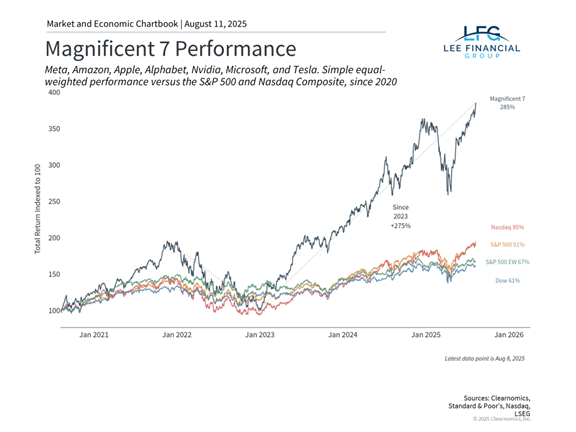
Large-cap technology companies, particularly those capitalizing on AI developments, are typically grouped under the “Magnificent 7” designation. This collection – Apple, Microsoft, Nvidia, Amazon, Alphabet, Meta, and Tesla – currently comprises approximately 35% of the S&P 500 and includes seven of the eight most valuable companies. Many earn the “hyperscaler” label due to their substantial computing infrastructure investments aimed at satisfying AI application demands.
During market conditions where a limited number of stocks propel most performance gains, focusing on historical context, present valuations, and asset distribution becomes increasingly critical. Examining how comparable concentration periods have unfolded previously can guide investors toward more informed long-term financial decisions.
Technological advancement powers long-term market growth
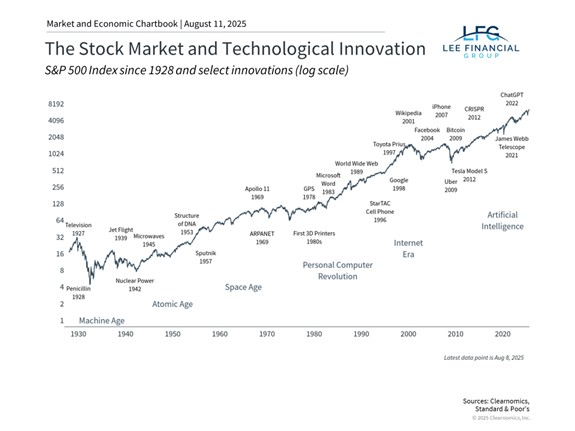
While AI and railroads may appear unrelated, history demonstrates that revolutionary technologies typically follow comparable trajectories. During the 1860s, railroad equities controlled American markets similarly to how technology stocks dominate today. The Pennsylvania Railroad company once held the distinction of being the world’s largest corporation and, together with other railroad enterprises, commanded a substantial market share. This naturally generated investor excitement and elevated valuations that would resonate with contemporary market participants.
This cycle has occurred repeatedly throughout history. The 1990s dot-com surge, when investors concentrated almost entirely on internet enterprises, offers perhaps the most relevant recent illustration. However, dating back to the 1800s, telegraph systems, electrical power, and telephone networks revolutionized urban centers and spawned numerous new enterprises. Throughout the 20th century, electronics and computing advances transformed every aspect of society and commerce, even preceding internet development.
These technological waves shared common characteristics: initial doubt, swift acceptance, market excitement, and ultimate incorporation into the wider economy. Railroad systems didn’t vanish but became integral components of transportation and logistics industries, supporting overall economic growth. Although many dot-com enterprises collapsed during the late 1990s and early 2000s, numerous others evolved into today’s technology giants.
Regarding long-term investment strategy, it’s essential to consider not merely individual corporations, but how emerging technologies influence broader markets and economic systems. The genuine value of innovation lies in enhanced productivity and efficiency across all business sectors. The crucial distinction is that while individual company stock prices may fluctuate rapidly, the complete economy-wide impact requires considerably more time to materialize.
Historical evidence demonstrates that valuations equal growth in importance
Currently, the question isn’t whether AI will prove significant, but whether existing valuations are justified. With the S&P 500 trading at 22.5x price-to-earnings, approaching the record high of 24.5x, investors are paying premiums that presume these trends will maintain their current momentum.
What factors drive elevated Magnificent 7 valuations? Initially, recent estimates indicate U.S. private AI investment reached $109 billion in 2024, with hundreds of billions more announced this year. This amount surpasses numerous countries’ entire GDP and significantly exceeds comparable international investments. During recent quarters, investors have responded favorably to announcements of increasingly substantial AI infrastructure expenditures. This represents a notable change from less than a year ago when investors questioned whether these corporate investments would generate returns.
Additionally, numerous companies and individual users have quickly embraced AI technologies, generating increasing computing power demand. This explains why “hyperscalers” like Microsoft and NVIDIA have experienced soaring market capitalizations, with both reaching valuations exceeding $4 trillion. This also explains why new data center demand and their power requirements remain investor priorities.
These corporations are perceived as constructing infrastructure enabling other businesses to implement AI technologies, similar to how 19th-century railroad companies built transportation infrastructure supporting all commerce. While this creates substantial long-term value, the timeline for achieving returns remains unpredictable.
The difficulty lies in markets frequently overestimating how quickly transformative technologies will produce profits, even when long-term potential may be genuine. The 1990s provide a warning example. During that period, some investors believed conventional valuation methods no longer applied to internet companies. When reality failed to meet expectations, the Nasdaq declined 78% from its peak, and many companies failed or were purchased. Nevertheless, the internet did transform the economy, just not within the timeframe or manner that peak valuations suggested.
Balancing potential with concentration exposure
Likewise, while the Magnificent 7 companies may have guided markets upward, they have also led declines. For instance, in 2022 when interest rates increased rapidly due to inflation, these stocks declined approximately 50% on average.
Given that the Magnificent 7 now constitutes such a substantial portion of major market indices, virtually all investors hold these stocks in their portfolios. For those who have emphasized technology stocks, their portfolio weightings may exceed intended levels.
Maintaining excessive portfolio concentration in few investments is commonly called “concentration risk,” representing the opposite of diversification. These companies have shown growth and profitability. However, having significant portfolio dependence on a small company group, regardless of their success, can create volatility as trends shift. Even exceptional companies can experience underperformance periods.
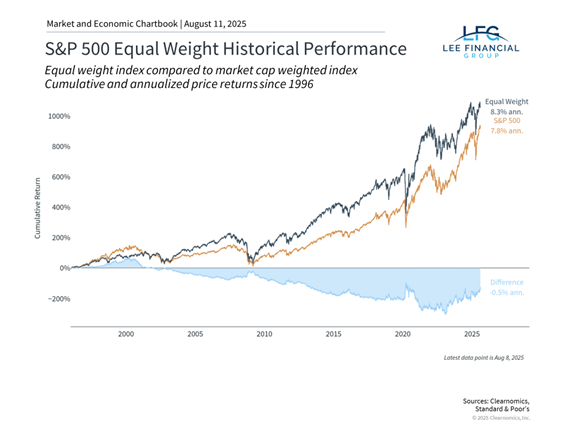
For context, consider the equal-weighted S&P 500 displayed in the above chart, which assigns identical importance to each company regardless of size. This methodology has historically delivered different return patterns than the standard market-capitalization weighted index, sometimes outperforming when large companies face challenges.
Since mega-cap tech companies have recently performed well, some investors may find it unexpected that an equal-weighted index has still outperformed over the past 30 years. This emphasizes the importance of not exclusively focusing on recent market drivers and current headlines.
This doesn’t suggest investors should completely avoid technology stocks. Instead, it underscores the significance of maintaining balance and proper asset allocation.
The bottom line? Present AI developments present both opportunities and risks for investors. Financial success involves not selecting winning stocks, but sustaining appropriate portfolio balance aligned with long-term objectives.




October Market Commentary – The Fed Hikes as Treasury Yields Rise