July delivered a split stock market and a geopolitical conflict in the Strait of Hormuz that drove oil prices higher. August brought a market rebound: the S&P 500 closed the month at 7,686.14, climbing 196 points to record its first positive month since May. The Nasdaq Composite finished at 26,370.89, while the Dow Jones Industrial Average ended at 53,185.90.
The geopolitical story, however, remains unresolved. Mid-August data showed July consumer prices cooled slightly as energy costs fell 1.5%. However, this was recorded before new tensions flared in the Middle East. By late August, U.S. forces struck Iranian launchers on Larak Island in response to threats in the waterway, prompting retaliatory actions against U.S. forces.
Meanwhile, at the Jackson Hole economic symposium, Federal Reserve Chair Kevin Warsh signaled that recent inflation data does not show meaningful improvement. He indicated the Fed still has “work to do” to reach its 2% target. Consequently, the probability of a rate hike at the mid-September meeting jumped to 66.1%, up from 35% prior to his speech.
Let’s get into the data:
- Employment: August jobs data was pending as of early September, but July showed a dip in payrolls by 23,000, with unemployment holding at 4.1%. Previous months were also revised downward.
- Inflation: July’s Consumer Price Index (CPI) rose just 0.1% for the month and 3.4% over the year. Core inflation rose 0.2% monthly and 2.5% annually. Energy costs dropped 1.5% for the month but remained 14.7% higher than a year ago.
- Interest Rates: Markets are pricing in a likely September rate hike, with futures showing a 66.1% probability of an increase from the current 3.50% to 3.75% target range.
- Economic Growth: Second-quarter GDP growth was estimated at a 1.5% annual rate, but third-quarter projections from the Atlanta Fed suggest a much hotter 4.6% growth rate.
What Does the Data Add Up To?
The July CPI report offered a snapshot of cooling energy prices, but Fed Chair Warsh noted that broader inflation trends remain concerning. He emphasized that current financial conditions do not yet feel restrictive enough to declare victory.
The real-time economic challenge is playing out in the Strait of Hormuz, a critical global shipping lane. Oil prices (West Texas Intermediate) rebounded to $83.90 per barrel by late August, driven by the renewed threat of sea mines and military strikes.
Despite these geopolitical and interest rate pressures, the stock market moved higher. Market volatility (VIX) settled at 14.43, and corporate bond spreads tightened. Investors appear to be weighing July’s cooler inflation data more heavily than the Fed’s recent warnings about a potential September rate hike.
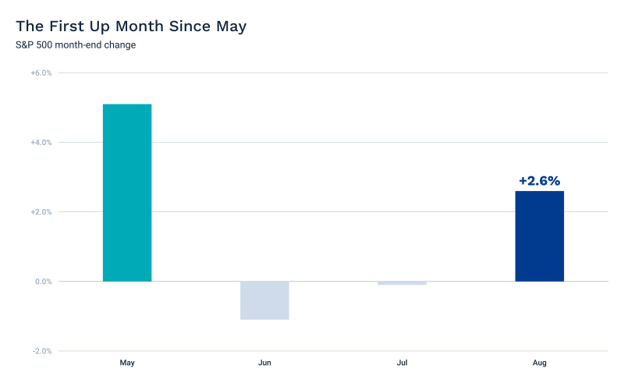
Chart of the Month: The First Up Month Since May
The S&P 500 shifted from two consecutive down months to a solid gain in August. This rebound reflects market pricing based on current sentiment, rather than the pending August inflation data, which had not yet been released at month’s end.
Equity Markets in August
- S&P 500: August closed at 7,686.14, up 196.42 points.
- Nasdaq Composite: Rose 997.04 (increase of 3.93%) to 26,370.89.
- Dow Jones Industrial Average: Finished at 53,185.90, up 700.87 points.
Bond Markets in August
- 10-Year Treasury Yield: Ended at 4.75%, unchanged from July 31st level.
- 30-Year Treasury Yield: Finished near 5.25%, down slightly from 5.27% at end of July.
- Bond Funds: Long-term yields nevertheless moved sharply higher on August 31st as rising oil prices renewed concerns about inflation and a potential Federal Reserve rate increase.
The Smart Investor
Seeing green in your portfolio statements is always a welcome relief, especially while juggling back-to-school routines for the kids and a heavy professional workload. However, it is important to separate a single positive month from your long-term strategy. The stock market’s August rebound and July’s cooling inflation data are positive signs, but they do not erase the ongoing energy shocks or shifting Fed policies.
If the daily financial headlines feel contradictory, lean on your financial plan. We are here to help you evaluate your timeline, manage cash flow needs for your growing family, and keep your wealth strategy on track through market cycles.
September Market Commentary – Stocks Rebound, The Test Waits
September Market Commentary – Stocks Rebound, The Test Waits
July delivered a split stock market and a geopolitical conflict in the Strait of Hormuz that drove oil prices higher. August brought a market rebound: the S&P 500 closed the month at 7,686.14, climbing 196 points to record its first positive month since May. The Nasdaq Composite finished at 26,370.89, while the Dow Jones Industrial Average ended at 53,185.90.
The geopolitical story, however, remains unresolved. Mid-August data showed July consumer prices cooled slightly as energy costs fell 1.5%. However, this was recorded before new tensions flared in the Middle East. By late August, U.S. forces struck Iranian launchers on Larak Island in response to threats in the waterway, prompting retaliatory actions against U.S. forces.
Meanwhile, at the Jackson Hole economic symposium, Federal Reserve Chair Kevin Warsh signaled that recent inflation data does not show meaningful improvement. He indicated the Fed still has “work to do” to reach its 2% target. Consequently, the probability of a rate hike at the mid-September meeting jumped to 66.1%, up from 35% prior to his speech.
Let’s get into the data:
What Does the Data Add Up To?
The July CPI report offered a snapshot of cooling energy prices, but Fed Chair Warsh noted that broader inflation trends remain concerning. He emphasized that current financial conditions do not yet feel restrictive enough to declare victory.
The real-time economic challenge is playing out in the Strait of Hormuz, a critical global shipping lane. Oil prices (West Texas Intermediate) rebounded to $83.90 per barrel by late August, driven by the renewed threat of sea mines and military strikes.
Despite these geopolitical and interest rate pressures, the stock market moved higher. Market volatility (VIX) settled at 14.43, and corporate bond spreads tightened. Investors appear to be weighing July’s cooler inflation data more heavily than the Fed’s recent warnings about a potential September rate hike.
Chart of the Month: The First Up Month Since May
The S&P 500 shifted from two consecutive down months to a solid gain in August. This rebound reflects market pricing based on current sentiment, rather than the pending August inflation data, which had not yet been released at month’s end.
Equity Markets in August
Bond Markets in August
The Smart Investor
Seeing green in your portfolio statements is always a welcome relief, especially while juggling back-to-school routines for the kids and a heavy professional workload. However, it is important to separate a single positive month from your long-term strategy. The stock market’s August rebound and July’s cooling inflation data are positive signs, but they do not erase the ongoing energy shocks or shifting Fed policies.
If the daily financial headlines feel contradictory, lean on your financial plan. We are here to help you evaluate your timeline, manage cash flow needs for your growing family, and keep your wealth strategy on track through market cycles.
RECENT ARTICLES
October Market Commentary – The Fed Hikes as Treasury Yields Rise
Medicare Open Enrollment Starts October 15: What You Can Change for 2027
September Market Commentary – Stocks Rebound, The Test Waits
Gift or Loan: Helping a Child With a Down Payment
The Diversification Rule That Resets With Every Vest