The financial markets barely had time to digest shifting tariff policies and the ongoing evolution of artificial intelligence before geopolitical tensions escalated with the administration’s conflict in Iran. After an initial strong reaction, markets appeared to recover somewhat, as investors seemed to lean toward the hope that the conflict would not turn into a prolonged event. However, oil prices have increased precipitously. Recent guidance from the White House suggests that securing strategic victories abroad is taking precedence over the immediate impact of rising oil prices, though the administration is pulling available levers to help cushion the economic shock.
On the domestic front, the labor market delivered a surprising loss of 92,000 jobs, alongside a downward revision of the previously reported numbers for January. For professionals leading teams and managing departments, this indicates a broader labor market that is struggling to shake off the combined weight of AI disruption, tariff uncertainty, and ongoing immigration crackdowns.
Where do we stand as we move through March? We are navigating a slowing economy, a struggling labor market, and the added risk of a conflict that could disrupt the flow of oil, potentially driving up prices and broader inflation.
Let’s get into the data:
- Job Losses: Non-farm payrolls fell by 92,000 in February. The U.S. Bureau of Labor Statistics reported this decline in stark contrast to the expected increase of 50,000 jobs, which pushed the overall unemployment rate up to 4.4%.
- Inflation Held Steady: The Bureau of Labor Statistics reported that the Consumer Price Index for February grew at a rate of 2.4% over the past twelve months, remaining unchanged.
- Consumer Sentiment Dropped: The University of Michigan Consumer Sentiment Index fell to a reading of 55.5 in early March, representing a 1.9% decline from the previous month.
- Economic Growth Revised Downward: Real GDP saw its first revision for the fourth quarter; the previous estimate of 1.4% growth was cut exactly in half to 0.7%.
What Does the Data Add Up To?
Despite the challenging headlines, it is not all gloom and doom. The Business Roundtable CEO Economic Outlook Index actually rebounded in the first quarter. Companies are planning to increase their capital spending, largely focusing on integrating AI. However, unlike normal economic cycles where increased capital expenditures and rising sales predictably lead to more hiring, this intense focus on AI makes the employment outlook a bit more uncertain.
Consumers are reacting by keeping their spending relatively flat, showing only a 0.1% increase in January. Meanwhile, the personal savings rate bumped up half a percentage point to 4.5%, signaling that families are becoming more cautious and building their cash reserves for the future.
The critical question now surrounds the Federal Reserve. There has been clear pressure from the administration for rate cuts, and Kevin Warsh, the current nominee for Fed Chairman, appears poised to deliver them. However, with prices already elevated and a potential longer-term increase in gas prices due to the conflict in Iran, the threat of inflation—or even stagflation—remains a very real risk to the broader economy.
Chart of the Month: Labor Turns to the Negative
Looking at the stark reality of the numbers reveals a labor market that is struggling. Strong performance reported in one month is being revised downward the next, culminating in the market turning negative in February.
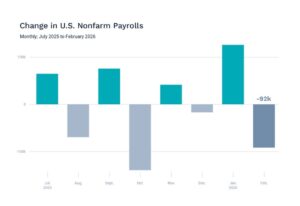
Source: Bureau of Labor Statistics; Axios Visuals
Equity Markets in February
- The S&P 500 finished February down 0.9%.
The industries hit the hardest included software and insurance—sectors closely tied to many of your own professions—as investors reacted aggressively to the potential for AI disruption in these fields. By the end of the month, the tone shifted slightly, with market observers beginning to feel that the sell-off may have been an overreaction.
Interestingly, the market barely reacted to the U.S. Supreme Court’s February 20th ruling against broad tariffs, with the index rising only slightly from the day of the ruling through the end of the month. Sector-wise, Utilities were the biggest winners in February with a 9.9% gain, followed closely by Energy, which was up 8.8%. Conversely, Consumer Discretionary struggled the most, posting a 5.4% decline.
Bond Markets in February
The 10-year U.S. Treasury ended the month with a yield of 4.21%, a slight decrease from 4.24% the prior month.
- The 30-year U.S. Treasury ended February at 4.64%, down from 4.84%.
- The Bloomberg U.S. Aggregate Bond Index returned a positive 1.64% in February.
- The Bloomberg Municipal Bond Index—a highly relevant benchmark for our high-tax-bracket clients—returned 1.25% for the month.
The Smart Investor
Between managing a demanding career and keeping up with your children’s school schedules, it can be incredibly difficult to remain focused on your financial goals when faced with relentless news headlines. Trying to sift through conflicting data or make sense of every developing geopolitical trend often leads to decision paralysis.
The best way to navigate extreme volatility is to lean on the financial plans we built together before the volatility hit. Your long-term investment strategy was explicitly crafted to account for market swings, economic downturns, and periods of uncertainty. So far, nothing has fundamentally derailed those long-term objectives.
As we approach the end of tax season, we encourage you to focus instead on your family’s specific goals for the upcoming year. In periods of extreme market volatility, a strategy like dollar-cost averaging makes excellent sense. If you are expecting a tax refund—or receiving a Q1 performance bonus—setting up a systematic plan to invest those funds over time can help minimize the impact of daily market shocks.
We are always here to answer your questions, adjust your strategy if your life circumstances change, and help you navigate the bumps along the way!
March Commentary – Shocks at Home and Abroad
March Commentary – Shocks at Home and Abroad
The financial markets barely had time to digest shifting tariff policies and the ongoing evolution of artificial intelligence before geopolitical tensions escalated with the administration’s conflict in Iran. After an initial strong reaction, markets appeared to recover somewhat, as investors seemed to lean toward the hope that the conflict would not turn into a prolonged event. However, oil prices have increased precipitously. Recent guidance from the White House suggests that securing strategic victories abroad is taking precedence over the immediate impact of rising oil prices, though the administration is pulling available levers to help cushion the economic shock.
On the domestic front, the labor market delivered a surprising loss of 92,000 jobs, alongside a downward revision of the previously reported numbers for January. For professionals leading teams and managing departments, this indicates a broader labor market that is struggling to shake off the combined weight of AI disruption, tariff uncertainty, and ongoing immigration crackdowns.
Where do we stand as we move through March? We are navigating a slowing economy, a struggling labor market, and the added risk of a conflict that could disrupt the flow of oil, potentially driving up prices and broader inflation.
Let’s get into the data:
What Does the Data Add Up To?
Despite the challenging headlines, it is not all gloom and doom. The Business Roundtable CEO Economic Outlook Index actually rebounded in the first quarter. Companies are planning to increase their capital spending, largely focusing on integrating AI. However, unlike normal economic cycles where increased capital expenditures and rising sales predictably lead to more hiring, this intense focus on AI makes the employment outlook a bit more uncertain.
Consumers are reacting by keeping their spending relatively flat, showing only a 0.1% increase in January. Meanwhile, the personal savings rate bumped up half a percentage point to 4.5%, signaling that families are becoming more cautious and building their cash reserves for the future.
The critical question now surrounds the Federal Reserve. There has been clear pressure from the administration for rate cuts, and Kevin Warsh, the current nominee for Fed Chairman, appears poised to deliver them. However, with prices already elevated and a potential longer-term increase in gas prices due to the conflict in Iran, the threat of inflation—or even stagflation—remains a very real risk to the broader economy.
Chart of the Month: Labor Turns to the Negative
Looking at the stark reality of the numbers reveals a labor market that is struggling. Strong performance reported in one month is being revised downward the next, culminating in the market turning negative in February.
Source: Bureau of Labor Statistics; Axios Visuals
Equity Markets in February
The industries hit the hardest included software and insurance—sectors closely tied to many of your own professions—as investors reacted aggressively to the potential for AI disruption in these fields. By the end of the month, the tone shifted slightly, with market observers beginning to feel that the sell-off may have been an overreaction.
Interestingly, the market barely reacted to the U.S. Supreme Court’s February 20th ruling against broad tariffs, with the index rising only slightly from the day of the ruling through the end of the month. Sector-wise, Utilities were the biggest winners in February with a 9.9% gain, followed closely by Energy, which was up 8.8%. Conversely, Consumer Discretionary struggled the most, posting a 5.4% decline.
Bond Markets in February
The 10-year U.S. Treasury ended the month with a yield of 4.21%, a slight decrease from 4.24% the prior month.
The Smart Investor
Between managing a demanding career and keeping up with your children’s school schedules, it can be incredibly difficult to remain focused on your financial goals when faced with relentless news headlines. Trying to sift through conflicting data or make sense of every developing geopolitical trend often leads to decision paralysis.
The best way to navigate extreme volatility is to lean on the financial plans we built together before the volatility hit. Your long-term investment strategy was explicitly crafted to account for market swings, economic downturns, and periods of uncertainty. So far, nothing has fundamentally derailed those long-term objectives.
As we approach the end of tax season, we encourage you to focus instead on your family’s specific goals for the upcoming year. In periods of extreme market volatility, a strategy like dollar-cost averaging makes excellent sense. If you are expecting a tax refund—or receiving a Q1 performance bonus—setting up a systematic plan to invest those funds over time can help minimize the impact of daily market shocks.
We are always here to answer your questions, adjust your strategy if your life circumstances change, and help you navigate the bumps along the way!
RECENT ARTICLES
October Market Commentary – The Fed Hikes as Treasury Yields Rise
Medicare Open Enrollment Starts October 15: What You Can Change for 2027
September Market Commentary – Stocks Rebound, The Test Waits
Gift or Loan: Helping a Child With a Down Payment
The Diversification Rule That Resets With Every Vest