September turned the page from waiting to acting. Following a stock-market rebound in August, investors faced a more complicated inflation picture: the August consumer price report showed a faster monthly increase, driven partly by gasoline, even as annual core inflation eased. At its September meeting, the Federal Reserve raised its benchmark interest rate by a quarter percentage point, citing inflation that remained elevated.
The effects of higher rates were likely visible well beyond the Fed’s announcement. Treasury yields rose across the curve, mortgage rates increased, and credit spreads widened. Meanwhile, stock returns diverged: the S&P 500 finished slightly lower, the Nasdaq gained, and the Dow fell more substantially. Oil prices also remained volatile, keeping energy costs in focus. September’s story was much broader than the relatively small move in the S&P 500 suggested.
Let’s get into the data:
- Hiring picked up in August, with September’s report still ahead at month-end. Nonfarm payrolls rose by 162,000 in August, and the unemployment rate held at 4.1%, according to the Bureau of Labor Statistics release on September 4. June and July payroll estimates were revised higher by a combined 55,000 jobs, bringing July’s revised increase to 21,000. At September’s close, the September employment report was scheduled for October 2.
- Monthly inflation accelerated, while annual core inflation eased. The Consumer Price Index rose 0.4% in August on a seasonally adjusted basis, compared with 0.1% in July. Gasoline prices increased 3.9%, accounting for more than one-third of the monthly rise. Annual headline inflation remained at 3.4%, while annual core inflation, which excludes food and energy, declined from 2.5% to 2.4%. These figures describe August prices reported in September.
- The FOMC raised rates and cited still-elevated inflation. On September 16, the Federal Open Market Committee increased the federal funds target range by 25 basis points to 3.75%–4.00%. The statement described economic activity as expanding at a solid pace, noted that inflation remained elevated, and identified geopolitical developments as one source of uncertainty.
- Borrowing costs moved higher alongside Treasury yields. The 10-year Treasury yield increased from 4.75% on August 31 to 5.29% on September 30. Freddie Mac’s average 30-year fixed mortgage rate rose from 6.71% in the September 3 weekly release to 7.03% in the September 24 release, the last published during the month. The ICE BofA US High Yield Index option-adjusted spread widened from 2.63 to 3.12 percentage points between August 31 and September 30.
What Does the Data Add Up To?
September’s central tension was an economy that continued adding jobs alongside inflation that had not settled into a consistent downward path. The August CPI report contained both encouraging and concerning details for families planning their financial futures: annual core inflation eased, but monthly headline inflation accelerated as gasoline prices rose. The Fed’s September projections put median PCE inflation at 3.7% for 2026, measured from the fourth quarter of 2025 to the fourth quarter of 2026. That projection remained above its 2% longer-run goal.
Energy added another layer of uncertainty. West Texas Intermediate crude spot prices rose from $87.03 a barrel on August 31 to $96.16 on September 29, the latest observation available in the cited FRED series at the September cutoff. The path was uneven, including a reading above $107 in mid-September. Those September oil-price movements did not cause the already-reported August CPI increase, but they kept attention on the potential for further energy-related pressure in subsequent inflation reports.
The change in financing conditions mattered for both households and businesses. Higher mortgage rates can make upgrading to a new family home more expensive, while Treasury yields provide benchmarks used throughout credit markets. Wider high-yield spreads indicated that investors also required a larger premium to lend to lower-quality corporate borrowers. Taken together, these developments pointed to tighter financing conditions, even though the S&P 500’s monthly decline was modest.
For investors, the distinction between bond income and bond prices is especially relevant right now. Rising yields can reduce the market value of existing fixed-rate bonds while improving the income available on new purchases and reinvestments. Which effect matters most depends partly on when you will need the money and how your holdings are structured. September was a reminder to evaluate stocks, bonds, and cash according to the roles they serve in a financial plan, rather than using a single market index as a measure of the entire portfolio.
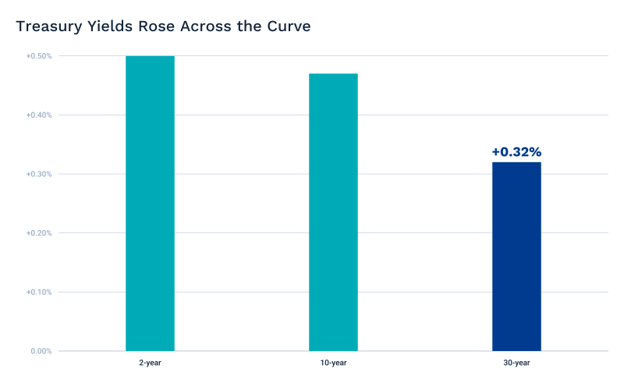
Chart of the Month: Treasury Yields Rose Across the Curve
Treasury yields rose across the maturities shown below. From September 1 through September 29, the 2-year yield increased by 0.50 percentage point, the 10-year by 0.47 percentage point, and the 30-year by 0.32 percentage point. The move extended across both shorter- and longer-term borrowing benchmarks.
Equity Markets in September
The S&P 500 declined 0.45% in September, closing the month at 7,651.54. The Nasdaq Composite gained 1.86%, finishing at 26,861.06, while the Dow Jones Industrial Average fell 4.29% to 50,906.05. These figures represent price changes from August 31 to September 30 and exclude dividends.
The month’s closing figures also conceal movement along the way. The S&P 500 closed at 7,551.81 on September 16, recovered to 7,764.70 on September 21, and then gave back much of that advance before month-end. Stocks did not respond to September’s economic and policy developments in a straight line.
The difference between the Nasdaq’s gain and the Dow’s decline was another defining feature. The indexes hold different mixes of companies and use different weighting methods, so they can deliver very different results in the same economic environment. For a diversified investor, September’s experience depended on the composition of the portfolio, including exposure to companies and sectors that performed differently from the headline indexes.
Bond Markets in September
September was a difficult month for fixed income. The Bloomberg U.S. Aggregate Bond Index returned approximately −2.7%, according to Madison Partners’ September market update, as rising yields pressured the broad investment-grade bond market.
The 2-year Treasury yield rose from 4.34% at August’s close to 4.88% on September 30. The 10-year increased from 4.75% to 5.29%, while the 30-year moved from 5.25% to 5.64%. Those were increases of 54, 54, and 39 basis points, respectively. One basis point equals 0.01 percentage point.
The rise in yields put downward pressure on existing fixed-rate bond prices, with longer-duration holdings generally more sensitive to the change. In high-yield corporate debt, widening spreads added a separate source of pressure beyond the Treasury move. Higher yields may improve future income opportunities, but September demonstrated that bonds can experience meaningful short-term price declines while continuing to serve a longer-term role in a portfolio.
The Smart Investor
When you are busy managing a medical practice or leading a team, a nearly flat headline stock index can feel reassuring. It does not necessarily mean a quiet month for your investments, however. September brought higher Treasury yields, more expensive mortgage financing, and a wide gap between the performance of major stock indexes.
Those changes are useful inputs to a financial plan, but they do not automatically call for a new strategy. Money needed soon for school tuition, investments intended to generate income, and assets held for long-term growth each serve different purposes. A month like September is an opportunity to revisit those purposes and confirm that the portfolio still reflects them.

October Market Commentary – The Fed Hikes as Treasury Yields Rise
October Market Commentary – The Fed Hikes as Treasury Yields Rise
September turned the page from waiting to acting. Following a stock-market rebound in August, investors faced a more complicated inflation picture: the August consumer price report showed a faster monthly increase, driven partly by gasoline, even as annual core inflation eased. At its September meeting, the Federal Reserve raised its benchmark interest rate by a quarter percentage point, citing inflation that remained elevated.
The effects of higher rates were likely visible well beyond the Fed’s announcement. Treasury yields rose across the curve, mortgage rates increased, and credit spreads widened. Meanwhile, stock returns diverged: the S&P 500 finished slightly lower, the Nasdaq gained, and the Dow fell more substantially. Oil prices also remained volatile, keeping energy costs in focus. September’s story was much broader than the relatively small move in the S&P 500 suggested.
Let’s get into the data:
What Does the Data Add Up To?
September’s central tension was an economy that continued adding jobs alongside inflation that had not settled into a consistent downward path. The August CPI report contained both encouraging and concerning details for families planning their financial futures: annual core inflation eased, but monthly headline inflation accelerated as gasoline prices rose. The Fed’s September projections put median PCE inflation at 3.7% for 2026, measured from the fourth quarter of 2025 to the fourth quarter of 2026. That projection remained above its 2% longer-run goal.
Energy added another layer of uncertainty. West Texas Intermediate crude spot prices rose from $87.03 a barrel on August 31 to $96.16 on September 29, the latest observation available in the cited FRED series at the September cutoff. The path was uneven, including a reading above $107 in mid-September. Those September oil-price movements did not cause the already-reported August CPI increase, but they kept attention on the potential for further energy-related pressure in subsequent inflation reports.
The change in financing conditions mattered for both households and businesses. Higher mortgage rates can make upgrading to a new family home more expensive, while Treasury yields provide benchmarks used throughout credit markets. Wider high-yield spreads indicated that investors also required a larger premium to lend to lower-quality corporate borrowers. Taken together, these developments pointed to tighter financing conditions, even though the S&P 500’s monthly decline was modest.
For investors, the distinction between bond income and bond prices is especially relevant right now. Rising yields can reduce the market value of existing fixed-rate bonds while improving the income available on new purchases and reinvestments. Which effect matters most depends partly on when you will need the money and how your holdings are structured. September was a reminder to evaluate stocks, bonds, and cash according to the roles they serve in a financial plan, rather than using a single market index as a measure of the entire portfolio.
Chart of the Month: Treasury Yields Rose Across the Curve
Treasury yields rose across the maturities shown below. From September 1 through September 29, the 2-year yield increased by 0.50 percentage point, the 10-year by 0.47 percentage point, and the 30-year by 0.32 percentage point. The move extended across both shorter- and longer-term borrowing benchmarks.
Equity Markets in September
The S&P 500 declined 0.45% in September, closing the month at 7,651.54. The Nasdaq Composite gained 1.86%, finishing at 26,861.06, while the Dow Jones Industrial Average fell 4.29% to 50,906.05. These figures represent price changes from August 31 to September 30 and exclude dividends.
The month’s closing figures also conceal movement along the way. The S&P 500 closed at 7,551.81 on September 16, recovered to 7,764.70 on September 21, and then gave back much of that advance before month-end. Stocks did not respond to September’s economic and policy developments in a straight line.
The difference between the Nasdaq’s gain and the Dow’s decline was another defining feature. The indexes hold different mixes of companies and use different weighting methods, so they can deliver very different results in the same economic environment. For a diversified investor, September’s experience depended on the composition of the portfolio, including exposure to companies and sectors that performed differently from the headline indexes.
Bond Markets in September
September was a difficult month for fixed income. The Bloomberg U.S. Aggregate Bond Index returned approximately −2.7%, according to Madison Partners’ September market update, as rising yields pressured the broad investment-grade bond market.
The 2-year Treasury yield rose from 4.34% at August’s close to 4.88% on September 30. The 10-year increased from 4.75% to 5.29%, while the 30-year moved from 5.25% to 5.64%. Those were increases of 54, 54, and 39 basis points, respectively. One basis point equals 0.01 percentage point.
The rise in yields put downward pressure on existing fixed-rate bond prices, with longer-duration holdings generally more sensitive to the change. In high-yield corporate debt, widening spreads added a separate source of pressure beyond the Treasury move. Higher yields may improve future income opportunities, but September demonstrated that bonds can experience meaningful short-term price declines while continuing to serve a longer-term role in a portfolio.
The Smart Investor
When you are busy managing a medical practice or leading a team, a nearly flat headline stock index can feel reassuring. It does not necessarily mean a quiet month for your investments, however. September brought higher Treasury yields, more expensive mortgage financing, and a wide gap between the performance of major stock indexes.
Those changes are useful inputs to a financial plan, but they do not automatically call for a new strategy. Money needed soon for school tuition, investments intended to generate income, and assets held for long-term growth each serve different purposes. A month like September is an opportunity to revisit those purposes and confirm that the portfolio still reflects them.
RECENT ARTICLES
October Market Commentary – The Fed Hikes as Treasury Yields Rise
Medicare Open Enrollment Starts October 15: What You Can Change for 2027
September Market Commentary – Stocks Rebound, The Test Waits
Gift or Loan: Helping a Child With a Down Payment
The Diversification Rule That Resets With Every Vest